
Academics


Academics
Ready For College, Built For Life
Marmion offers a rigorous, college preparatory curriculum grounded in the Catholic and Benedictine tradition. Our holistic approach challenges students to grow intellectually, think critically, and lead with integrity.
In our focused learning environment, students form strong bonds, support one another, and strive for excellence, together. College is just the start—Marmion students leave ready for life.
- 100% of Marmion seniors who apply to college are accepted.
- 90% of Marmion seniors who were accepted to college will attend a four-year institution and 10% will attend a two-year institution.
- 85% of our graduating seniors earn academic scholarships or honors*
*This updated number is reflective of the average of the past five years
Academic Center and Counseling Department
The Marmion Academy Academic Center provides assistance to students who are experiencing difficulties with their academics. The program currently serves over 60 students with diagnosed learning differences in the form of Student Support Plans (Accommodations Plans). Additionally, support is available to any student who may be struggling academically in any subject(s).
Program Goals
The goal of the Academic Center is to help students become independent and self-sufficient learners. As students become more independent, academic support is slowly reduced. We strive towards academic and personal success by encouraging personal responsibility, empowerment, and self-advocacy.
Services Offered
Each student at Marmion Academy has access to a School Counselor as well as a College Guidance Counselor. Services offered include:
- Check-ins with all students to assess academic performance and social-emotional well-being
- Providing students with strategies to improve on academic deficits
- Social-emotional counseling
- Accommodation plans for students with documented learning disabilities*
- Teacher and peer tutoring for students needing assistance in a specific course or concept is available when schedules permit
- Daily Math Labs, Science Labs, and World Language Labs (drop-in tutoring for any student needing additional help)
- ACT/SAT accommodations application assistance
In addition to our College Guidance Department, Marmion Academy provides each student with access to Naviance. The Naviance Readiness Solution is a comprehensive tool set that helps students assess and develop essential competencies needed to be successful after high school. For more information, please contact Mr. Dan Thorpe, Director of College Guidance, at dthorpe@marmion.org.
Faculty
Christina Lipp, 630-897-6936 ext. 381, clipp@marmion.org
Counselor for last names A-F
Kristin Woosley, 630-897-6936 ext. 237, kwoosley@marmion.org
Counselor for last names G-N
Sherry Tietz, 630-897-6936 ext. 215, stietz@marmion.org
Counselor for last names O-Z
Dan Thorpe, 630-897-6936 ext. 245, dthorpe@marmion.org
College Guidance
Dave Rakow, 630-897-6936 ext. 305, drakow@marmion.org
Director of Academic Center
Kelsey Damato, 630-897-6936 ext. 256, kdamato@marmion.org
Asst. Director of Academic Center
English
Philosophy
The mission of the Marmion English Department is to help students become accomplished readers, writers, and speakers; to improve critical thinking and problem-solving skills; to recognize various literary forms, genres, and terminology; to encourage close textual analysis; to promote and inspire a love of reading and writing; and to foster an appreciation for the English language.
Faculty
- Robert Rebenstorf, Department Chair: 630-897-6936 ext. 234; rrebenstorf@marmion.org
- Rebecca Cann: 630-897-6936 ext. 234; rcann@marmion.org
- Jenna Micko: 630-897-6936, ext. 234; jmicko@marmion.org
- Greg Ott: 630-897-6936, ext. 234; gott@marmion.org
- Maura Purse: 630-897-6936 ext. 234; mpurse@marmion.org
Summer Reading Lists
Please click here to access the Summer Reading lists for each class.
Courses
English I, English I Honors (Full year course required of freshmen)
The first course in English focuses attention on the study of grammar, correct usage, and writing skills. The program includes a challenging reading program in the classics of Western literature, vocabulary building, and writing, with particular emphasis on the paragraph and short essay. Methods of library research for the research paper are included.
English II, English II Honors (Full year course required of sophomores)
English 2 broadens the perspectives and hones the abilities acquired in the previous year. The role of the author as an interpreter of society is examined through a regional survey of world literature. Composition assignments stress analytical skills. One research paper is required. English 2 Honors reads additional texts and writes additional expository essays.
English III, English III Honors (Full year course required of juniors)
In the Junior year students read significant works from the major periods of American literature. Writing projects include expository essays, creative writing, and a research paper.
AP English III Language and Composition (Option to fulfill full-year requirement – juniors)
AP Language and Composition is a college-level course that offers students the opportunity to earn college credit and /or advanced college placement in English. Additionally this course focuses on rhetoric and writing, particularly analyzing how texts use rhetorical strategies to create meaning, purpose, and effect. Students will also study and compose essays integral to an introductory college composition course, such as narrative, analysis, argumentation, and a long-term research paper. This course will prepare the student to take the AP Language and Composition exam. Instructor Recommendation/Dept. Approval/Dir. of Academic Services Approval
Credits = 1.0
English IV (Full year course required of seniors)
The Senior year focuses on the writing of expository and argumentative essays. Logic and logical fallacies are studied. Intensive studies in the genres of fiction, poetry, and drama are intended to deepen the students’ understanding and appreciation of these literary forms. A full-length research paper on a literary topic is required.
English IV Dual Credit (Option to fulfill full-year course requirement – seniors)
This course provides an opportunity for motivated students to earn both college and high school credit in English at the same time. In conjunction with Waubonsee Community College, this is a college level course that mirrors the curriculum of English 101 and English 102 offered at most colleges and universities. It focuses on the writing of Narrative, Expository, and Argumentative essays and concentrates on the writing process, identifying and responding to different audiences and rhetorical situations, and understanding the conventions of format and structure relating to academic writing. Practice in research, critical thinking and textual analysis is emphasized.
AP English IV Literature and Composition (Option to fulfill full-year course requirements – seniors)
AP Literature and Composition is a college-level course that offers students the opportunity to earn college credit and /or advanced college placement in English. Students will learn to textually analyze, critically review and comparatively evaluate a myriad of literary genres. Writing is also a key component of this course. It will prepare the student to take the AP Literature and Composition exam.
Prerequisite: Instructor recommendation; Department and Student Services Office approval.
Film & Literature (One semester course – junior/senior elective)
This course introduces the student to film and literature as related art forms. Through lectures, discussions, and the viewing of films, the student will review elements of literary and cinematic style, learn basic film and camera terminology, and comprehend how classification into genres contributes to a deeper appreciation and understanding of literature and film. The student will write several papers, give a presentation on his choice of a major movie director, and write personal responses to movies viewed at home or in theaters.
Publications 1 (One Semester Course – junior/senior elective)
This course emphasizes the skills and knowledge required to produce a newspaper and yearbook. Staff members will participate in the publication process from the brainstorming phase to the final product distribution. Students will learn how to write effective headlines, captions, and leads while writing feature, news, opinion, and sports stories for the newspaper, as well as activity summaries for the yearbook. While writing in journalistic style, students learn how to conduct an interview, develop quality-questioning techniques, and write effective headlines, captions, and leads. Students learn to objectively express interpretations of events with a high emphasis on journalism ethics, independence, accuracy, impartiality and truth. Students are exposed to the history of journalism, media law and ethics, and the basics for using a computer for publishing. Impact of current events and how the professional media examines these daily news events is observed. This course is meant to introduce students to the world of journalism as well as prepare them for a career in this field. Students that complete this course can further advance their writing skills and take on a leadership role in Publications II. Meets 5 days per week in the 1st Semester. 0.5 credits.
Publications 2 (One Semester Course – junior/senior elective)
This class is designed to provide advanced training in writing for students and will help them build on the skills learned in Publications I. Students will continue their hands-on experience in the process of producing the school’s newspaper and yearbook, while furthering their investigative skills, responsible reporting, and journalistic writing techniques. Students will read, respond to, and write their own news and feature articles. Students in this course are eligible to take on leadership roles on the newspaper and yearbook staffs. Motivation, responsibility, independence and self- direction are essential characteristics for a student who enrolls in this course. Meets 5 days per week in the 2nd Semester; Credits = 0.5; Pre-requisite = Publications 1
Fine Arts
Faculty
- Brian Birch, 630-897-6936 ext. 216, bbirch@marmion.org
Choir Director, Department Chair - Lisa Dzuricsko, 630-897-6936 ext. 219, ldzuricsko@marmion.org
Art Instructor - Louis Grissinger, 630-897-6936 ext. 251, lgrissinger@marmion.org
Ceramics Instructor - René Rosas, 630-89706936 ext. 216, rrosas@marmion.org
Band Director
MUSIC
Mission
All students can learn and will perform at a very high standard when there is an expectation for excellence. Making excellence a habit and practicing it everyday results in excellence always being expected. Our role as music teachers is to be inspirational and have the student take ownership in the process. We will offer students an environment that is based upon growth, with the expectation that students will be inspired to lead others. Upon graduation students have been given the tools necessary for further pursuit of musical and artistic objectives.
Courses
Marmion Rosary Band – (Full year course, all level elective. Meets five days a week from 6:40-7:25 AM)
The Marmion Rosary Band is a multi-faceted organization of which certain ensembles require all students to participate and certain ensembles, which allow for voluntary participation. Required ensembles are marching band and concert band. The concert band is further delineated as Wind Ensemble, Concert Band and Marmion Rosary Band. Students may opt to play in volunteer ensembles such as Jazz Band and Jazz Combo (which have their own course descriptions), pit orchestra (for musicals) and chamber ensembles. Pep Band falls into a special category as all students are required to play the home opener and closing basketball games, and are also required to play at three home games out of six. Students may volunteer to play more than three games and will receive credit/merit points for each game. Students may also work within their sections in choosing which games to play so that all parts are equitably covered and may also call each other to substitute in case of absence.
The Marching Band performance scheduled is dictated by the home football schedule and incorporates at least two marching band competitions. The concert band ensembles will schedule three principal schools concerts per year along with various competitions and clinics. Students are also expected to participate in solo and ensemble festival in late February/early March.
Participation in the band generates one credit per year, which counts in the G.P.A. 50% of that credit is group participation and 50% is private lesson. All band students are provided with private lesson during a student’s study hall period. Lessons are taught by the band director(s) unless a student opts to study with a pre-approved instructor; in which case the pre-approved instructor follows the Marmion Rosary private lesson rubric and provides the weekly lesson grade to the band director.
Course Fee: $60 for all students, additional $60 for Rosary student lessons, $40 instrument rental (for those students who need to use school instruments) other fees assessed as incurred*
Requirements: Mandatory participation in Music Booster fundraisers and Private lessons with course instructor or pre-approved instructor
Marmion Rosary Band for Honors Credit (Full year course, all level elective. Meets five days a week from 6:40-7:25 AM)
To receive honors credit for band, a student must be enrolled in at least two other honors courses. In addition to maintaining superior developmental habits students will present a project each quarter. This project will consist of a 700-word paper on a pre-approved subject relating to materials being students during the term. Topics may include 2) the historical/cultural perspective of a selected composition or associated compositions or a given time period, or 2) theoretical analysis that includes form, compositional technique, harmony and orchestration, or 3) discussion of technical demands for a selected composition and associated skills required for its performance, or 4) a conducting project with an evaluation, or 5) special topic pre-approved by the band director including an evaluation.
Course Fee: $60 for all students, additional $60 for Rosary student lessons, $40 instrument rental (for those who need to use school instruments) other fees assessed and incurred.
Requirements: Mandatory participation in Music Booster fundraisers and Private lessons with course instructor or pre-approved instructor.
Marmion Rosary Jazz Band (Full Year Course – all level elective Meets Monday’s and Wednesday from 6:00-7:00 PM)
The Marmion Rosary Jazz Band provides the opportunity to perform and learn about American Jazz Traditions. Jazz styles to be covered include Blues, Ragtime, Stride, Dixieland, Swing, Bebop, Latin, Rusion, and Afro-Cuban. This band performs four school concerts, and participates in area adjudicated jazz festivals. Additionally, the Jazz Band may perform on occasion at feeder schools and/or gala events.
Course Fee: assessed as incurred*
Requirements: Audition required for participation and must be part of the Marmion Rosary band or play requisite instrument.
Marmion Rosary Jazz Combo (Full Year Course – all level elective Meets Monday and Wednesday from 7:00 – 7:30PM )
The Marmion Rosary Jazz Combo provides the opportunity further explore improvisation and spontaneity in performance. A fundamental understanding of harmony, style and the use of melody to form motifs, are fundamental and will be further expounded upon in this course. This ensemble performs four school concerts, and participates in area adjudicated jazz festivals.
Course Fee: assessed as incurred*
Requirements: Audition required for participation and must be part of the Marmion Rosary Jazz Band or play requisite instrument.
Chorus I (Full Year Course – all level elective. Meets 3 days per week during Zero Period.)
The Marmion Men’s Chorus principle means of instruction is through the study, rehearsal, and performance of the finest musical literature appropriate to the level of the students. The curriculum provides knowledge and understanding of musical forms, styles, and major composers representative of each musical period and genre over a four-year curriculum. The chorus provides instruction in discriminating aural skills, developing vocal technical proficiency, and applying performance values.
Course Fee: $70 Entry fee for the original semester to cover concert uniform Fees such as, field trips, replacing lost or damaged music/materials etc. are assessed as incurred.
Requirements: Participation in Chorus requires mandatory participation in Music Boosters fundraising.
Honors Chorus I (Full Year Course – all level elective. Meets 3 days per week during Zero Period.)
The Marmion Men’s Chorus principle means of instruction is through the study, rehearsal, and performance of the finest musical literature appropriate to the level of the students. The curriculum provides knowledge and understanding of musical forms, styles, and major composers representative of each musical period and genre over a four-year curriculum. The chorus provides instruction in discriminating aural skills, developing vocal technical proficiency, and applying performance values.
The Honors Chorus is for students in the Marmion Men’s Chorus who wish to earn honors credit through additional participation and assessments demonstrating the student’s musical aptitude, leadership abilities, and dedication to the art. Students must meet the requirements outlined in the Choral Handbook in order to earn the honors credit.
Course Fee: Fees such as uniform rental, music, accompanist, awards, field trips etc. are assessed as incurred.
Requirements: Participation in Chorus also requires mandatory participation in Music Boosters fundraisers.
Music Appreciation for the Musician/Performer (One semester course Sophomore Elective. Not a core course. Meets 2 days per week.)
Musicianship for Musicians/Performers is for the serious music students who may wish to pursue advanced music opportunities at Marmion or college. Building on basic skills, students will expand their knowledge of the elements of music, primary musical periods of traditional Western music, and aural and rhythmic dictation. The study of various music genres will promote critical thinking and problem solving, enhance life-long learning, promote effective citizenship and expose students to the best of Western music traditions.
Requirements: For students in band, chorus, drama productions or requisite musical background. Must have basic knowledge or rhythm, pitch and clef.
Digital Music Composition (One Semester Course – Junior/Senior elective – Meets 5 days per week during 1st Semester)
EDM?! Dubstep?! Sound Design?! Music Business?! This project-based course is designed for students who are interested in music and/or the music industry. Students need not have previous experience in music to fully participate in this course. Students explore the world of digital music, using software and MIDI controllers to sample, loop, manipulate, and compose ones own pieces meeting.
AP Music Theory (Full Year Course – junior/senior elective. Taught only as students are available)
This is an advanced one-year course devoted to developing theoretical and analytical musical skills. Each student is equipped with a music station that includes an Alexis synthesizer, a computer with Sibelius 5.25, and electronic communication with the instructor. The curriculum has components of music history, sight singing and ear training, as well as providing the harmonic and melodic materials necessary for composition and musical analysis. In the past two years A composition is required each semester.
Pre-requisite: Instructor recommendation; Department and Student Services Office approval.
VISUAL ARTS
Mission
The Visual Art Department of Marmion Academy believes that the arts are an essential part of every student’s education. Art and design impact every facet of life. The creation and appreciation of art and design enriches the lives of the students and enhances perception and awareness of environment and culture. Art education values both process and product. Education in the arts encourages imaginative and creative approaches to problem solving. The visual art department instructs on media technique and composition exploring the elements and principles of art and design while promoting a love of the visual arts past and present.
Student Work Videos
- Mrs. Dzuricsko Spring 2021 Art Classes work:
- Art Explor: https://youtu.be/vpOK8xTdWIU
- Draw II: https://youtu.be/GI2KapWrHKY
- Art Appreciation Scratchboard: https://youtu.be/pX17QKwcjco
- Art Appreciation Portraits: https://youtu.be/98YWBt9v6Ao
- Art Appreciation Ceramic Relief Tiles: https://youtu.be/oI7P__8qeEI
- Mrs. Dzuricsko Fall 2020 Art Classes work are showcased in these videos. Thank you art students for your work this semester.
- Art Appr Powers of Ten https://youtu.be/A-YMrGew5OA
- Art Appr Scratchboard https://youtu.be/PmRrKt1VVFk
- Art Appr Portraits https://youtu.be/i2UmhZX4Rwc
- Draw I https://youtu.be/yDV5mdXujy8
- Art Explor https://youtu.be/7USOGSYqpzw
- Ceramics 1st Semester (2020-2021) Student Work: https://youtu.be/lao3DD6MMWc
- Tour of Ceramics Lab: https://youtu.be/tROtAUnWXRs
- Drawing: https://youtu.be/B-cvTNd2R28
- Art Appreciation 4th Quarter: https://youtu.be/43sN_pU07fI
- Art Explorations 4th Quarter: https://youtu.be/xkOecIUl5os
- Coffeehouse: https://youtu.be/O3woL2mTKqo
- Art Club: https://youtu.be/yGNG2p8Xs2s
Courses
Art Appreciation (One Semester Required Course for all Freshmen; Meets 2 days per week)
Credits = 0.25 (Non-Core Course) Course Fee: $50.00
This course is an introduction to the visual arts and an introduction to basic drawing and design. Freshmen are introduced to art projects, which will parallel what they are studying in art history and art theory. Subjects to be included are art technique, medium, art criticism, studies of value, understanding of color theory, and introduction to ceramic technique. This course is designed as an introduction to the offerings in the art department
Art Exploration (Full Year Course – JR/SR Elective; Meets 2 days per week in the Mixed Period)
Credits = 0.50 (Non-Core Course) Course Fee: $60.00
This course is intended for those students with limited time in their schedules but wish to explore various art forms. Each quarter will continue exploration in illustration, drawing, painting, rendering, proportion, and perspective.
Drawing I (One Semester Course – JR/SR Elective)
Credits = 0.5 (Non-Core Course)
Dual Credit Waubonsee
This course (listed as Basic Drawing I ART 120 at WCC) encompasses drawing of natural and artificial forms as well as interpretive and inventive processes. Line, shape, value, mass, proportions and volume are explored emphasizing the use of black and white media. The course also includes vocabulary development, individual and class critiques and exposure to contemporary and historical drawings.
Drawing II (One Semester Course – JR/SR Elective)
Credits = 0.5 (Non-Core Course)
Dual Credit Waubonsee
This course (listed as Basic Drawing II ART 121 at WCC) is a continuation of Drawing I (ART120), with development of skill in representation, interpretation, abstraction and non-objective drawing techniques. Students will explore color theory and application. Emphasis is on the use of charcoal, pastels, colored pencils, ink and collage materials. Course content includes vocabulary development, individual and class critiques and exposure to contemporary and historical drawings.
Painting (One Semester Course – JR/SR Elective)
Credits = 0.5 (Non-Core Course) Course Fee: $60.00
Painting is an introductory course covering the basic principles and techniques of the painting process. Beginning painting fundamentals includes value, color theory, mixing paints, mediums and using various surfaces. The instructor helps each student engage strategies for conceptual development by working through individual painting problems and emphasizing personal meaning and relevance to contemporary culture.
Art History 1: Pre-History to Romanticism (One Semester Course – JR/SR Elective)
Credits = 0.5 (Non-Core Course)
This course is a historical survey of the visual arts ranging from Prehistoric to Romanticism. Selected works of painting, sculpture, and architecture are studied in relation to the cultures that produced them. Students are introduced to work of the Prehistoric, ancient Greek and Roman and Medieval periods. During the second semester, students explore the classical styles of the Renaissance, the innovative styles of the Baroque and the large cultural shifts and technological developments of the Age of Enlightenment that shaped the 19th and 20th centuries. The course is primarily discussion/lecture with an emphasis on reading, writing, testing and research presentations.
Art History 2: Modern to Contemporary (One Semester Course – JR/SR Elective)
Credits = 0.5 (Non-Core Course)
Art History is a field and discipline that studies specific time periods and cultures. In Art History course students recognize the differences between Modernity, Postmodernity, and what is considered Contemporary art today. Lectures feature images of artwork, excerpts from literature, and relevant connections to current issues and events.
Ceramic Forms (Full year course – sophomore, junior, senior elective. Not a core course)
Course Fee: $70.00
Students create works of art in clay utilizing the processes of hand building, molds, wheel throwing, slip and glaze techniques, and the firing processes. Firing processes include kiln, pit and Raku. Students split the semester between learning to throw on the pottery wheel and creating artwork using hand-building clay projects. Additionally, students reflect upon the outcome of classroom experiences, explore cultural and historical connections, write about the process, make presentations about their progress at regular intervals, work individually and in groups, find direct correlations to other disciplines, and explore career options related to ceramics. Click here to view a short presentation on work completed in this class.
Digital Design (Full year course – junior/senior elective. Not a core course.)
Course Fee: $40.00
This course is designed to give students an understanding of how to use Photoshop to perform many different image-processing techniques. Through project work, students will learn how to use several tools for selecting, retouching images, layers, special filters, painting, digital photography and animation. Students will be encouraged to take the ACA exam (for an additional fee) at the end of the semester.
Engineering Design I & 2
Courses using “SolidWorks”, a 3D CAD software program used by Product Designers and Industrial Engineers. Students will learn the fundamental skills to make parts, assemblies, and Engineering Graphics (drawings} in this CAD program. Students interested in any area of Engineering (Aerospace, Industrial Machinery, Electronics, Architecture, Defense, etc.) or Product Design will benefit from these courses. Students will work toward earning a Certified SolidWorks Associate certificate. Learn more about Engineering Design 1: https://youtu.be/FEheh8QcF0Q
Web Design (Full year course – junior/senior elective. Not a core course.)
Course Fee: $40.00
Web Design is an introduction to the design, creation, and maintenance of web pages and websites. Students learn how to critically evaluate website quality, learn how to create and maintain quality web pages, learn about web design standards and why they are important, and learn to create and manipulate images. The course progresses from introductory work on web design to a culminating project in which students design and develop websites for personal or business use.
Leadership - JROTC
Mission
The mission of JROTC is “To motivate young people to be better Citizens.”
Note: The JROTC program is not a recruiting tool of the U.S. Army. There is no active or reserve military obligation incurred upon completion of the program.
Faculty
- LTC Daniel Williams – Department Chair/Senior Instructor
630-966-7646; dwilliams@marmion.org - MSG Joseph Fabish – Junior Army Instructor
630-966-7641; jfabish@marmion.org - SFC Robert Norton – Sophomore Instructor
630-966-7692; rnorton@marmion.org - SGM Andrew Weldon – Freshman Army Instructor
630-766-7693; aweldon@marmion.org
Course Descriptions
Military 1, ½ Credit, Full Year Course – Freshmen
This course is an introduction to leadership development and helps motivate cadets to assume leadership positions in today’s world and be better citizens. Cadets are familiarized with military courtesy and principles of organization. Students are introduced to basic skills in drill and ceremonies, air rifle safety and marksmanship, physical conditioning, and oral communication. The course provides an overview of citizenship through American history featuring the War Between the States and the history of Marmion Academy.
Military 2, ½ Credit, Full Year Course – Sophomores
The main emphasis of the course is leadership development. The course includes theories of leadership, principles of organization, assuming leadership roles and group dynamics. American military history is presented on the origins, purpose, and structure of the military services (with emphasis on the United States Army) in support of the nation and its objectives. The course further develops skills in military courtesies and discipline, map reading, drill and ceremonies, physical conditioning, citizenship and oral communication.
Military 3, ½ Credit, Full Year Course – Juniors
The emphasis of the course is on applied leadership. The interactions between the small-unit leader and his men are emphasized. Upperclassmen are prepared to assume the leadership roles in the Cadet Corps as seniors. Also included are the effects of the leader’s actions on discipline, motivation, and morale. Psychology of leadership includes concepts and traits of leadership as related to individual and group behavioral patterns. Additionally, techniques of communication and military history are reviewed.
Military 4, ½ Credit, Full Year Course – Seniors
This course emphasizes applied leadership and utilization of the battalion organization toward community service and citizenship. Emphasis is placed on all leadership positions from squad level to Battalion Staff positions, concentrating on being positions or responsibility versus positions of authority. Leadership techniques and concepts are put in to practice throughout the year with hands on experience at weekly formations, Battalion events, and classroom discussions. Motivating others, self-awareness towards self-improvement, communication strategies, and life after high school planning/discussions are all included as part of the capstone JROTC experience.
Leadership - LEAD
- Anthony Cirrincione – Department Chair; 630-897-6936 ext. 306; acirrincione@marmion.org
- Paul Chabura – 630-897-6936 ext. 258; pchabura@marmion.org
- Barb Ebert; 630-897-6936 ext. 267; bebert@marmion.org
- Andrew Lifka; 630-897-6936 ext. 283; alifka@marmion.org
- Student Director: Sam Wirth ’25
- Assistant Director for Media and Marketing: Nicholas De Leon ’25
- Assistant Director for Outreach: Samuel Lin ’25
- Assistant Director for Activities: Evan Paganelis ’25
- Assistant Director for Special Events: Matthew Sullivan ’25
Courses
- A foundational component in the study of personal leadership and personal responsibility.
- Provides an exploration of personal choices, attitudes, circumstances, and the idea of building lasting success by taking small steps.
- The concept of failure as an opportunity to learn,
- Creating good habits, and continuous learning.
- Creating a plan and working the plan, persevere and don’t give up
- A basic primer on The Benedictine Rule as it relates to leadership
- Understand and describe leadership behaviors
- Understand the ability to change
- Building on small successes leads to long-term rewards
- Personal awareness
- Understanding the Rule of Fraternity, the Rule of Group Chemistry, and the Rule of Empowerment
- Engage in highly interactive team building activities
- A continued study of personal responsibility and personal leadership.
- A study of accountability as it relates to oneself and others.
- A beginning study of group dynamics and group responsibility.
- A study of the attributes that great leaders must develop.
- Understand attributes great leaders need to develop
- Understand the concepts of paradigms and principles
- Understand the concepts of private victory and public victory
- The students will begin a formalized speech component as an integral communication tool.
- Group dynamics and group leadership
- A study of leadership research
- The Five Practices of Exemplary Leadership
- The Student Leadership Practices Inventory
- Understand the Five Practices of Exemplary Leadership
- Understand the results of their personal Leadership Practices Inventory
- Understand the stages of group development
- Continue to learn and lead group activities
- The Social Change Model of Leadership
- The Relational Leadership Model
- The 7-C’s of Social Change
- Solidify a personal philosophy of leadership
- Understand credibility as a core concept of leadership success
- Understand the relationship between ethics and leadership
- Understand the stages of group development and their role as a senior member of the LEAD Program
- How to lead a group
- Compare and contrast traditional and emergent paradigms of leadership
- Build an awareness of leadership issues facing our communities and society
- Create a leadership vision
Mathematics
Mission
The Mathematics Department seeks to challenge students through an integrated curriculum where skills and concepts are taught in a continuous manner. Each course is not an isolated learning experience, but rather part of a larger process. The use of multiple representations is emphasized to re-enforce a deeper conceptual understanding of the topics. Technology is used to assist and support the educational process. By the end of four years, the goal is to have our students leave not only well prepared for college, but also well equipped with critical-thinking and problem-solving skills that they can use in any career choice.
Faculty
- John Salomone – Department Chair; 630-897-6936 ext. 267; jsalomone@marmion.org
- John Breckenfelder; 630-897-6936 ext. 267; jbreckenfelder@marmion.org
- Barb Ebert; 630-897-6936 ext. 267; bebert@marmion.org
- Stephanie Ebert; 630-897-6936 ext. 267; sebert@marmion.org
- Joe Large ’97; 630-897-6936 ext. 240; jlarge@marmion.org
- Carol Kinzer; 630-897-6936 ext. 267; ckinzer@marmion.org
Courses
Algebra 1 (Full Year Course – freshmen; Regular, Enhanced, or Honors)
Algebra 1 is the skill building, gateway course to all upper level mathematics. In this class, the students learn to compute accurately, simplify algebraic expressions, write and solve equations, and investigate functions and their graphs. The Algebra skills are modeled in class, and then the students work collaboratively on many practice problems before they demonstrate their understanding through homework sets, quizzes and tests..
Geometry – Honors and Regular (Full Year Course – sophomores)
Geometry is a course that provides students with opportunities to deepen their understanding of two and three-dimensional objects and their properties. Deductive and inductive reasoning as well as investigative strategies in drawing conclusions are stressed. Properties and relationships of geometric objects include the study of: (a) points, lines, angles, and planes, (b) polygons, w/ special focus on quadrilaterals, triangles, and right triangles, and (c) circles. Students also develop an understanding of proof and logic through a curriculum that is designed to ultimately have the students approach a problem or real life situation in a logical way. Class projects and technology, such as graphing calculators and geometry sketchpad, are used to reinforce these concepts and to develop a deeper understanding of the material.
Pre-requisite: Algebra 1 or Placement Exam
Algebra 2 – Honors and Regular (Full Year Required Course – juniors)
In Algebra 2, the concepts from Algebra 1 are brought back and studied at a more in-depth level of understanding. Topics include: solving and graphing functions and equations; solving systems of equations; working with matrices and geometric transformations; quadratic equations and parabolas; the complex number system; polynomials; developing the binomial theorem; radical functions and rational exponents; exponential and logarithmic functions; rational functions; the various conic sections; and arithmetic and geometric sequences and series.
Pre-requisite: Algebra 1 & Geometry
Pre-Calculus with Trigonometry (Full Year Course – junior/senior elective)
Pre-Calculus is a transition course from high school to college-level mathematics. It is designed to prepare students for university-level mathematics, including AP Calculus. Students will be challenged to look at problems from the perspectives of algebra and geometry while being introduced to some concepts of calculus, such as limits and derivative. This course covers concepts of trigonometry, including the trigonometric functions, identities, vectors, parametric equations and polar coordinates. Other topics include: modeling with polynomial, exponential and logarithmic functions; systems of equations with emphasis on matrices; analytic geometry; and, discrete mathematics (probability, sequences and series). Technology such as graphing calculators and computers will be used to enhance the curriculum.
Pre-requisite: Algebra 2 Instructor Recommendation; Department and Student Services Office approval.
Advanced Topics in Mathematics (Full Year Course – senior elective)
This course will explore a variety of advanced topics in mathematics, and is offered as a fourth-year alternative course to Pre-Calculus with Trigonometry. Topics may include the following: probability; exploring data; statistics; planning and scheduling algorithms; linear programming; voting/election systems; game theory; and, information science.
Pre-requisite: Algebra 2 Instructor Recommendation; Department and Student Services Office approval.
Advanced Placement Calculus 1 (Full Year Course – junior/senior elective)
Advanced Placement Calculus 1 is a challenging, upper-level math course that offers students a first-hand look at the deep integration between math and physics. Topics covered include: Limits; Continuity; Rates of Change; Differentiation; Applications of Derivatives (including problems from Physics, Economics, and other fields); Integrals; Differential Equations; Applications of Definite Integrals; Sequences; and Improper Integrals. At the end of the course, senior-level students are expected to take the AP Calculus AB Exam, which can gain college credit for one semester of college-level Calculus. Underclassmen students will not take the AP Exam, but rather continue onto Advanced Placement Calculus 2
Pre-requisite: Pre-Calculus with Trigonometry Instructor Recommendation; Department and Student Services Office approval. AP Exam Expected (for Seniors only) – Current AP Exam Fee applies.
Advanced Placement Calculus 2 (Full Year Course – senior elective)
Advanced Placement Calculus 2 is a challenging, upper-level math course that reviews the topics covered in Advanced Placement Calculus 1 in greater depth and detail. In addition, L’Hopital’s Rule, Improper Integrals, Power Series, Taylor Series, Sequences and Series, Convergence Testing, Parametric Functions, Vectors, and Polar Functions are covered to complete the material for the BC Calculus Exam. Once the material for the BC Calculus Exam is covered, other topics in Multivariable Calculus, Differential Equations, Linear Algebra, Real Analysis, and Discrete Mathematics are explored. Students are expected to take the AP Calculus BC Exam, which can gain college credit for two semesters of college-level calculus. The AP Calculus BC Exam score includes a Calculus AB subscore.
Pre-requisite: AP Calculus 1 Instructor Recommendation; Department and Student Services Office approval. AP Exam Expected – Current AP Exam Fee applies.
Advanced Placement Statistics (Full Year Course – junior/senior elective)
Advanced Placement Statistics is a course that explores four main areas of the subject: organizing data, designing data collection, probability, and inference. Students use computers and graphic calculators to assist them in their work. They solve statistics problems using real data collected by real statisticians to discover relationships in science, medicine, sports, social sciences, and everyday living. By the end of the course students will design a study, collect the data, analyze it, and use statistical tests to verify the confidence that they have in their findings. Students are expected to take the AP Statistics Exam at the end of the course.
Pre-requisite: Algebra 2 Instructor Recommendation; Department and Student Services Office approval. AP Exam Expected – Current AP Exam Fee applies.
Advanced Placement/Dual Credit Computer Science (Full Year Course – senior elective) AP Exam Expected – Current AP Exam Fee Applies; Dual Credit Fee (paid directly to Loyola University); Course Fee: $40.00 + $195; Credits = 1.0 (NCAA)
Advanced Placement Computer Science emphasizes object-oriented programming methodology with an emphasis on problem solving and algorithm development and is meant to be the equivalent of a first-semester introductory college course in computer science. Students learn the basics of computer programming through the use of JAVA computer language and compilers. This course satisfies both the AP Computer Science curriculum and the Loyola University COMP 170 curriculum for dual credit. Students are expected to take the AP Statistics Exam at the end of the course.
Prerequisite: Algebra 2 Instructor Recommendation / Department Approval / Dir. of Student Academic Services Approval
Science
Philosophy
To develop an innovative science education system integrating Science, Technology, Engineering, and Mathematics (STEM) to benefit our students in this 21st century world.
Faculty
- Anthony Cirrincione; Department Chair; 630-897-6936 ext 306; acirrincione@marmion.org
- Andy Damato ’01; 630-897-6936 ext. 280; adamato@marmion.org
- Dr. Victor Pinks, II ’72 – Co-Chair; 630-897-6936 ext. 223; vpinks@marmion.org
- Dr. Steven Poppen; 630-897-6936 ext. 273; spoppen@marmion.org
- Anthony Tinerella ’84; 630-897-6936, atinerella@marmion.org
Courses
Three science classes are required for graduation of which two are laboratory based. Students are encouraged to exceed the minimum science requirement. All courses meet 5 days per week and count for 1 credit unless otherwise noted.
The Marmion science curriculum is individualized for personal interests, aptitude and deeper conceptual development while fulfilling all required Illinois State and National science core standards.
Biology (Full Year Required Course – Freshmen)
Biology covers topics found in the fields of cellular biology, molecular biology, biochemistry, and genetics. This course is built around six key concepts that provide unifying explanations for how and why structures are formed and processes occur throughout the study of biology. One of the major goals of the course is to learn how to recognize and apply biological concepts in everyday life. This is accomplished through daily classroom discussions and weekly laboratory investigations.
Honors Biology (Includes Additional Lab Section)
Honors Biology is an advanced biology course that tracks with the AP Biology syllabus. This course is quick paced to allow more in-depth conceptual and laboratory analyses. It is the prerequisite for AP Biology. The course will cover the 4 Big Ideas used in the AP class: The process of evolution drives the diversity and unity of life; Biological systems
utilize free energy and molecular building blocks to grow, to reproduce, and to maintain dynamic homeostasis; Living systems store, retrieve, transmit and respond to information essential to life processes; and finally, Biological systems interact, and these systems and their interactions possess complex properties.
Advanced Placement Biology (Includes Additional Lab Section; Full Year Course) Odd Years
The AP Biology course is designed to be taken by students after the successful completion of a first year course in Biology and a first year course in Chemistry. It aims to provide students with the conceptual framework, factual knowledge, and analytical skills necessary to deal critically with the rapidly changing science of biology. The course includes topics regularly covered in a college biology course for majors. This course prepares students to take the AP Biology Exam.
Chemistry (Full Year Required Course – Sophomores or Juniors; Pre-requisite: Biology)
This physical science course emphasizes atomic/molecular structure of matter and how structure explains interactions occurring in the various physical states of matter. Student laboratory work is a “hands-on” experience correlating with the lecture material. Strong mathematic and writing skills are expected.
Honors Chemistry (Includes Additional Lab Section; Full Year Course – Sophomore Elective in place of Chemistry Instructor Recommendation / Dept. Approval)
Honors Chemistry is an advanced chemistry course that tracks with the AP Chemistry syllabus. This course is quick paced to allow more in-depth conceptual and laboratory analyses. It is the prerequisite for AP Chemistry. Topics to be studied involve matter and its properties and changes, atomic structure, periodic table arrangement, ionic and covalent bonds, chemical reactions, stoichiometry, gases, solutions, energy and chemical changes, acids and bases reactions, redox reactions, electrochemistry, and fundamentals of nuclear chemistry.
Advanced Placement Chemistry (Includes Additional Lab Section; Full Year Course – Pre-requisite: Biology, Chemistry; Instructor Recommendation / Dept. Approval) Even Years
The Advanced Placement Chemistry course is designed to be taken by students after successful completion of a first-year course in Chemistry and a first-year course in Biology. Students gain a deep understanding of fundamental chemical concepts. Understanding these concepts will prepare the student to be successful in a first-year college Chemistry course and to take the AP Chemistry Exam.
Physics (Full Year Course – JR/SR Elective; Pre-requisite: Biology, Chemistry, Completed or currently enrolled in Algebra 2)
This course is designed to provide a fundamental working knowledge of the theories of Physics. Necessary mathematical skills are taught and integrated in course material. A historical development of topics puts contemporary physics in context. Laboratories emphasize further conceptual refinement through hands on experience and computer simulation modeling. Topics will be presented at an introductory freshman college physics
level.
Honors Physics (Includes Additional Lab Section; Full Year Course – JR/SR Elective in place of Physics; Pre-requisite: Biology, Chemistry, Completed or currently enrolled in Pre-Calculus)
This course is designed to provide a fundamental working knowledge of the theories of Physics. Necessary mathematical skills are taught and integrated in course material. A historical development of topics puts contemporary physics in context. Laboratories emphasize further conceptual refinement through hands on experience and computer simulation modeling. This is an Advanced Placement Physics preparation course; topics will be presented as an introductory AP Physics course.
Advanced Placement Physics (Includes Additional Lab Section; Full Year Course – SR Elective; Pre-requisite: Calculus (completed or currently enrolled), Honors Physics; Instructor Recommendation / Dept. Approval)
AP Physics C – Mechanics Exam Expected – Current AP Exam Fee Applies
The Advanced Placement Physics course is to be taken by students after successful completion of Honors Physics. Throughout the course, students will explore the following areas of mechanics: kinematics, Newton’s laws of motion, work, energy, power, linear momentum, circular motion and rotation, oscillations and gravitation. Calculus is used throughout in coordination with student texts. Laboratories emphasize further conceptual refinement and application through student led experimental design and exploration. Students are expected to take the AP Physics C – Mechanics exam at the end of the course.
Anatomy / Physiology (Full Year Course – Senior Elective; Approval of Dir. of Student Academic Services)
This course is designed primarily for those students interested in a related profession pertaining to the human body. Emphasis is on the appearance, structure and location of body systems. Emphasis is also on the function and processes of each body system.
Geology (One Semester Course (1st Semester) – JR/SR Elective) Meets 5 days per week
In this one semester course, students study the general formation of the earth and the earth’s history. Students will be able to identify certain rocks, minerals, and fossils. Earthquakes, volcanoes, weathering, and erosion are also studied as they pertain to the earth.
Astronomy (One Semester Course (2nd Semester) – JR/SR Elective) Meets 5 days per week
This lab course covers the general history of astronomy with an emphasis on galaxies, constellations, time and time travel. The origin of the solar system and the evolution of the earth and its atmosphere are also studied.
Science Research 1 (One Semester Course: Junior/Senior Elective; Pre-requisites: Must meet requirements of Senior Honors Thesis Program)
Students develop, with the assistance and guidance of instructors, an independent research project to include a written and oral report to be submitted to the entire Science Department by the last week of the semester. Students seek to integrate Math & Science into their thesis on a contemporary topic. This is considered an elite level of learning and will be handled with formality to include family and audience open to public of which Science Department evaluators are in attendance.
Science Research 2 (One Semester Course: Junior/Senior Elective; Pre-requisites: Science Research 1)
Students develop, with the assistance and guidance of instructors, an independent research project to include a written and oral report to be submitted to the entire Science Department by the last week of the semester. Students seek to integrate Math & Science into their thesis on a contemporary topic. This is considered an elite level of learning and will be handled with formality to include family and audience open to public of which Science Department evaluators are in attendance.
Engineering Research 1 (One Semester Course: Junior/Senior Elective; Pre-requisites: Must meet requirements of Senior Honors Thesis Program)
Students develop, with the assistance and guidance of instructors, an independent research project to include a written and oral report to be submitted to the entire Engineering Department by the last week of the semester. Students seek to integrate Math, Science and Engineering into their thesis on a contemporary topic. This is considered an elite level of learning and will be handled with formality to include family and audience open to public of which Engineering Department evaluators are in attendance.
Engineering Research 2 (One Semester Course: Junior/Senior Elective; Pre-requisites: Engineering Research 1)
Students develop, with the assistance and guidance of instructors, an independent research project to include a written and oral report to be submitted to the entire Engineering Department by the last week of the semester. Students seek to integrate Math, Science and Engineering into their thesis on a contemporary topic. This is considered an elite level of learning and will be handled with formality to include family and audience open to public of which Engineering Department evaluators are in attendance.
Engineering Design 1 (Full Year Course (Honors / No Dual Credit) – SO/JR/SR Elective; No prerequisite)
Engineering Design is course where students will learn to use “SolidWorks”, a 3D CAD (Computer Aided Design) software program used by Designers and Industrial Engineers. Students will learn the fundamental skills to make parts, assemblies and drawings. Students interested in any area of Engineering (Aerospace, Industrial Machinery, Electronics, Architecture, Defense, etc.) or Product Design will benefit from this course. Students will work toward earning a Certified SolidWorks Associate (CSWA) certificate. The CSWA test will be offered at the end of the course. Students must have a computer that meets the requirements of the SolidWorks program. Learn more about Engineering Design 1: https://youtu.be/FEheh8QcF0Q
Applied Engineering Design 1 (Full Year or One Semester Schedule options available (Honors and Dual Credit) – SO/JR/SR Elective; Prerequisite: Engineering Design, CSWA Certificate)
Applied Engineering Design 1 is an extension of Engineering Design 1 . Emphasis is placed on the preparation for students to work with companies on sponsored projects. Such preparation includes Advanced Parts Modeling techniques, Flow Simulation and Mechanical Simulation methods. There will be a segment dedicated to the proper format and ongoing maintenance of project notes throughout the course. There will be an ongoing focus on business and personal communication skills growth to prepare students for real world collaboration with project team members and outside companies. This course and its prerequisite prepare students for the Applied Engineering Design 2-5 sequence. This course offers dual credit through Waubonsee Community College for EGR 101. Students must have a computer that meets the requirements of the SolidWorks program. Learn more about Applied Engineering Design 1: https://youtu.be/4rLTqHRZXvw
Applied Engineering Design 2, 3, 4, & 5 (One Semester Course – Honors / No Dual Credit – JR/SR Elective; Meets 5 days per week for 1 Semester; Prerequisites: Previous Applied Engineering course by number (if applicable);
CSWA Certificate; Applied Engineering Design 1; Physics is highly recommended but not required.)
In the Applied Engineering Design 2-5 course sequence students work on simulation prototyping jobs for local, national and international companies utilizing multiple skills in engineering and interpersonal communication. This course requires dedication and personal initiative. Students will be communicating directly with company engineers on their projects and graded for their business and interpersonal team communication skills. In turn, the companies reward students with formal letters of recognition of work done for submission of feasible project designs. These letters are highly influential in helping students obtain college acceptance, increased scholarship funding and career opportunities. Students must have a computer that meets the requirements of the SolidWorks program.
About the Marmion CPARC Engineering Program (Applied Engineering Design 2, 3, 4, & 5)
Marmion CPARC is the “Computational Prototyping And Research Center” located at Marmion Academy. Marmion CPARC is an engineering program for business/education collaboration opportunities. Students must be enrolled in an Applied Engineering Design course AND have a CSWA certification to work on company projects. Marmion CPARC offers students, outside businesses and educational associates a collaborative learning/research atmosphere to tackle real world problems. Students are rewarded with letters of recognition from businesses for any collaborative work performed for these businesses. Solving these problems affords students an opportunity to see their hard work and dedication in the STEM fields translate into college/career success.
Social Science
Philosophy
The Social Studies Department of Marmion Academy, in compliance with the overall philosophy of the Academy, is concerned with the students’ Christian principles, democratic ideologies, college preparation, and development to live in a modern society. Our aim is to provide an atmosphere in which each student can use methods of inquiry to search out the truth. Better understanding of the complexities of modern society requires each student to be capable of knowing facts, practice critical evaluation, understanding the basic values, articulating judgments, and having compassion dealing with his fellow man through the study of past and present historical, political, social, and economic behavior.
Department Objectives
- To help students discover basic principles guiding human behavior so they can better discern and discuss problems, issues and values of modern society.
- To assist and encourage students when they make critical evaluations.
- To help students become more aware of their historical, cultural, economic, and religious heritage, so that they can better understand the present in terms of the past.
- To facilitate the students’ understanding of the interacting forces influencing human behavior, and to better appreciate the demands that these forces place upon him as an individual and as a member of society.
- To incorporate at every level of instruction the dimension of moral values and Christian principles as they cast light on the role of the student in society and give direction to him in fulfilling his moral obligations.
Faculty
- Nicolette Welte; Department Chair; 630-897-6936 ext. 273; nwelte@marmion.org
- Frank Chapman – 630-897-6936 ext. 247; fchapman@marmion.org
- Jerry Chenski; 630-897-6936 ext. 283; jchenski@marmion.org
- Andy Damato ’01; 630-897-6936 280; adamato@marmion.org
- Barb Ebert; 630-897-6936 ext. 267; bebert@marmion.org
- Adam Guerra; 630-897-6936 ext 247; aguerra@marmion.org
- Andrew Hauser ’94; 630-897-6936 ext. 273; ahauser@marmion.org
- Mark Malkowski ’08; 630-897-6936 ext. 296; mmalkowski@marmion.org
- James Sanders; 630-897-6936 ext. 283; jsanders@marmion.org
Courses
World History (3123)
Full Year Required Course – Sophomores
Credits = 1.0 (NCAA)
World History is a comparative study of the growth and development of the major world civilizations from the earliest times to the present. The primary objective is to provide an understanding of the historical development of humanity within the context of various interrelating civilizations. The class starts with the earliest of civilizations (Egypt, Mesopotamia, Greece, Rome), and then focuses primarily on the modernization of the western world, including the Middle Ages, Renaissance, the development of rationalism and scientific thought, the French Revolution, the industrial revolution, imperialism, and the World Wars. Also, attention is given to the Orient, Africa, and Middle East.
Advanced Placement World History: Modern (3130)
Full Year Course – Sophomore Elective in place of World History
Placement based on Instructor Recommendation and Department Approval
AP Exam Expected – Current AP Exam Fee Applies
Credits = 1.0 (NCAA)
In AP World History: Modern, students investigate significant events, individuals, developments, and processes from 1200 to the present. Students develop and use the same skills, practices, and methods employed by historians: analyzing primary and secondary sources; developing historical arguments; making historical connections; and utilizing reasoning about comparison, causation, and continuity and change over time. The course provides six themes that students explore throughout the course in order to make connections among historical developments in different times and places.
Course Themes:
1. Humans and the Environment (ENV)
2. Cultural Developments and Interactions (CDI)
3. Governance (GOV)
4. Creation, Expansion, and Interaction of Economic Systems (ECN)
5. Social Interactions and Organization (SIO)
6. Technology and Innovation (TEC)
AP World History: Modern is designed to be the equivalent of an introductory college or university survey of modern world history. Students should be able to read a college-level textbook and write grammatically correct, complete sentences.
This course covers the requirements for World History and prepares students to take the AP World History Exam.
U.S. History (3233)
Full Year Required Course – Juniors
Prerequisite: World History
Credits = 1.0 (NCAA)
This course gives the student a survey knowledge, emphasizing development of social and political institutions, and providing background necessary for intelligent citizenship. The first semester covers the period from Reconstruction to World War I and the second semester spans the 1920’s to the 2020 Election.
Advanced Placement/Dual Credit U.S. History (3235)
Full Year Course – Junior Elective in place of US History
Prerequisite: World History Instructor Recommendation / Department Approval
AP Exam Expected – Current AP Exam Fee Applies
Course Fee: $72.00 Dual Credit Fee
Credits = 1.0 (NCAA)
This course covers all areas of U.S. History and prepares students to take the AP U.S. History Exam. This course also offers Dual Credit via Waubonsee College.
American Government (3441 / 3442)
One Semester Required Course – Seniors
Meets 5 days per week for one semester
Credits = 0.5 (NCAA)
This course focuses on the foundations and major institutions of the federal government and of the state of Illinois. Structures and functions of these governments and ancillary institutions will be examined. Also included in this course is a unit that satisfies the ISBE requirement of the Constitution Test.
Advanced Placement U.S. Government and Politics (3450)
One Semester Course – Senior Elective (in place of American Government)
Prerequisite: U.S. History / Department Approval
Credits = 0.5 (NCAA)
This course in United States Government and Politics will give students an analytical perspective on government and politics in the United States. This course includes both the study of general concepts used to interpret U.S. government and politics and the analysis of specific examples. It also requires familiarity with the various institutions, groups, beliefs, and ideas that constitute U.S. government and politics. Students will become acquainted with the variety of theoretical perspectives and explanations for various behaviors and outcomes. This course prepares students to take the AP U.S. Government Exam. Also included in this course is a unit that satisfies the ISBE requirement of the Constitution Test.
Disciplinary Practices: Concept Application, SCOTUS Application, Data Analysis, Source Analysis, and Argumentation.
Big Ideas: Constitutionalism (CON), Liberty and Order (LOR), Civic Participations in a Representative Democracy (PRD), Competing Policy-Making (PMI), and Methods of Political Analysis (MPA)
Economics (3541 / 3542)
One Semester Required Course – Seniors
Meets 5 days per week
Credits = 0.5 (NCAA)
This course is designed to introduce students to various economic systems with special focus on the U.S. economy and the key factors that cause the economy to expand or contract. Students will learn how they fit within our economic system as consumers, workers and citizens. Key topics such as how to become more informed consumers, how to conduct banking transactions, how to save and invest money, how to obtain credit, the values and drawbacks of credit, the various types of taxes, how to file a tax return will be discussed along with other financial related topics. The course will include a significant amount of class discussion and practical application. Also included in this course is a unit that satisfies the ISBE requirement of Consumer Education.
Advanced Placement Macro Economics (3550)
One Semester Course – Senior Elective (in place of Economics)
Prerequisite: US History / Department Approval
AP Exam Expected – Current AP Exam Fee Applies
Credits = 0.5 (NCAA)
This semester-long course gives students a thorough understanding of the principles of economics that apply to the function of economic systems as a whole. Beyond the study of basic economic concepts like scarcity and supply and demand, this course places emphasis on national income, fiscal and monetary policy, measures of economic performance and growth and international trade.
This course covers the requirements for Consumer Economics and prepares students to take the AP Macro Economics Exam.
Psychology (3311)
One Semester Course – JR/SR Elective
Meets 5 days per week in the 2nd Semester
Credits = 0.5 (NCAA)
This course provides students with an overview of the field of psychology and the study of human behavior. Students are made aware of the psychological facts, principles, and phenomena associated with each of the major subfields within psychology. Topics will range from the biological basis of behavior, the learning process, research methodology and ethics, to development and abnormal behavior.
Intro to Philosophy (Honors and Dual Credit – PHL 100) (3345)
One Semester Course – JR/SR Elective
Meets 5 days per week in the 1st Semester
Dual Credit Fee: $36.00
Credits = 0.5 (NCAA)
This course provides an overview of the major fields of philosophy including metaphysics, epistemology, logic and ethics. Fundamental questions may include: What is the meaning of life? Does God exist? Are we free? What can we know? What makes a good argument? How should we live? This will include a study of the recurrent and persistent human principles and philosophical problems pertaining to the validity of knowledge, the nature of truth, the nature of identity, free will and determination, moral values, and religious belief systems. This course will also provide the opportunity for Dual Credit through Waubonsee Community College for PHL 100.
Intro to Ethics (Honors and Dual Credit – PHL 105) (3355)
One Semester Course – JR/SR Elective
Meets 5 days per week in the 2nd Semester
Dual Credit Fee; $36.00
Credits = 0.5
This course is a study of the principal ethical theories and concepts of human conduct and character, as well as a critical evaluation of these theories and concepts as they apply to particular moral issues and decisions. Students study ethical theories such as ethical egoism, utilitarianism, Kantianism, virtue ethics, Divine Command Theory, and moral relativism, and consider how these views apply to moral issues related to such topics as suicide, sex and marriage, war, terrorism, legal punishment, animal rights, the environment, and other current moral problems.
Principles of Business (3631)
One Semester – JR/SR Elective
Meets 5 days per week in the 1st Semester
Course Fee: $10.00
Credits = 0.5
This course is designed to teach students how businesses are created and structured, explain core marketing principles, selling strategies and techniques, learn basic accounting concepts, compare and contrast large corporations versus small businesses and franchises, discuss ethical considerations in the business environment and review legal issues that impact the way businesses operate.
History of Chicago (3242)
One Semester Course – JR/SR Elective
Meets 5 days per week in the 2nd Semester
Credits = 0.5
The History of Chicago is a semester long class designed to develop your knowledge about the city’s history and culture. The course will cover Chicago’s history chronologically and along the way we will study art, architecture music, crimes, disasters, politics, civil rights, neighborhoods and sports, which have shaped and defined the “Windy City.” We will be using a variety of primary sources (newspapers, letters, photographs, documents, journals) as we examine the history of this dynamic city from different points of view
Accounting (3642)
One Semester Course – JR/SR Elective
Meets 5 days per week in the 2nd Semester
Course Fee: $45.00
Credits = 0.5
This course is an introduction to the preparation and analysis of financial statements. Specific topics include the accounting model, general-purpose financial statements and accounting for assets, liabilities, and equity. This course will also include an explanation of what accounting is and the role it plays in business and our personal lives.
Intro to Marketing (Dual Credit) (3835)
One Semester Course – JR/SR Elective
Meets 5 days per week in the 2nd Semester
Course Fee: Dual Credit Fees Apply (paid directly to Loyola University)
Credits = 0.5 (NCAA)
This course is an introduction to the principles, concepts, strategy and tactics of marketing. This course provides an overview of marketing, the art of building relationships between products and services and unique consumers, businesses and markets.
Intro to Law (3323)
Full Year Course – SO/JR/SR Elective
Meets 3 days per week for the full year during I Period
Credits = 0.5
This is a year-long course that meets three times a week during I Period. It is designed to introduce students to the basic legal concepts related to substantive and procedural law, cases, statutes, and the constitution. The course will develop their legal vocabulary and analytical skills with a concentration on Trial Advocacy, Business Law, Civil Law, Constitutional Law and Criminal Law to help prepare students to participate in Mock Trial competitions. This course will educate the students as to the American legal system, legal terms and concepts, and will help develop critical thinking, poise and public speaking skills.
Intro to Law 2 (3333)
Full Year Course – SO/JR/SR Elective
Prerequisite: Intro to Law 1 / Department Approval
Meets 3 days per week for the full year during the Mixed Period
Credits = 0.5
This course would provide a basic introduction to additional areas of law not covered in Introduction to Law I. The goal of the course would be to complete a well-rounded coverage of fundamental legal concepts and current jurisprudence across a broad array of legal disciplines. The course would also provide selected areas of focused attention on areas of law specifically relevant to young adults beginning post-secondary education.
Theology
Mission
The Theology Department seeks to impart to all students the Benedictine spiritual hallmarks of: Love of Christ and love of learning, cultivation of a personal prayer life, instilling a sense of community that includes a call for service to the common good and respect for the individual, hospitality, stewardship of God’s creation, and humility, the acceptance of the demand for realism and accountability. At the same time, an effort is made to transmit the values of the Benedictine Rule and the tradition of monastic spirituality that has been so much a part of Marmion’s heritage. Students are encouraged to develop a lifelong relationship with Jesus and the Church. The Theology Department focuses on understanding and living the teachings, traditions and sacramental life of the Catholic Church.
The Theology Department offers:
- Comprehensive curriculum designed for faith formation and spiritual growth
- Rigorous academic standards, with a skills-based approach
- Yearly retreat offerings for each grade level
- Over 70 Kairos retreats completed: Led by seniors, attended by many faculty and staff, and with over 96% attendance rate from graduating seniors
- Sacramental offerings, including reconciliation on select days and during seasons of Lent and Advent
- Daily masses during activities period
- Monthly all school masses
Faculty
- Mark Waitkus ’08 – Department Chair; 630-897-6936 ext. 283; mwaitkus@marmion.org
- Fr. Michael Burrows, OSB ’70; 630-897-6936 ext. 260; michael@marmion.org
- Jerry Chenski; 630-897-6936 ext. 283; jchenski@marmion.org
- Fr. Theodore Haggerty, OSB; 630-897-6936; thaggerty@marmion.org
- Andrew Lifka ’16; 630-897-6936; alifka@marmion.org
- Fr. Antony Minardi ’08; 630-897-6936 ext. 330; aminardi@marmion.org
- James Sanders; 630-896-6936 ext 283; jsanders@marmion.org
Courses
Every Every student is required to take a Theology course each year. These courses are designed to continue the Christian formation of students and to build upon their basic foundation of Christian knowledge. All courses meet 5 days per week and count for 1 credit unless noted otherwise.
Theology 1 – Sacred Scripture/Catholicism:
Full Year Required Course – Freshmen
Honors and Regular
This course is designed to explore the rich history of the Old Testament, which contains the roots of not only Judaism but also Christianity. The course helps students comprehend the wealth of Judeo-Christian spiritual tradition, challenges students to grow in an appreciation of God, themselves, and other people, and better understand how God has worked in human history and still works in the present. In addition, the course introduces the Catechism of the Catholic Church and an overview of the important teachings and beliefs of the Catholic faith. The course presents an overview of how Catholics worship God and encounter Jesus Christ through the seven sacraments of the Church.
Theology 2 – Life of Christ/Introduction to Morality:
Full Year Required Course – Sophomores
Honors and Regular
First Semester – Encountering Jesus in the New Testament – This course explores the mission, the message, and the meaning of the person of Jesus Christ as revealed in the Christian Scriptures. It emphasizes Jesus is alive and manifests himself to us today through the Church, the People of God. It centers around the person of Christ revealed in Scripture and Tradition with a particular focus on the background, writers, and teachings of the four Gospels, and to the centrality of Jesus Christ to all Scripture.
Second Semester – Catholic Morality: Your Life in Christ – This course is an introduction to Catholic Morality based on Christ’s teaching to love God, love self, and love others as a basis for all moral decisions. Students explore and learn the moral concepts that govern the lives of Christ’s disciples. Students develop the critical skills necessary to make an informed ethical decision. They reflect on the moral situations of their lives and compare their values to the values of Christ and the values of society. They learn about virtue, vices, informed consciences, the reality of personal and social sin, natural law, forgiveness, respect for self, others and God.
Theology 3 – Church History/Catholic Social Teaching
Full Year Required Course – Juniors
Honors and Regular
In order to understand the development of Christianity and the nature of the Catholic Church today, it is important that we know its “story.” This course is intended to provide students with a wider understanding of the Church’s life and work over two millennia. The study of the Rule of Benedict is given a special place in this course, allowing each student to spend some time acquainting himself with a basic and formative document that has shaped the character of much of Western Civilization and the history of Marmion Abbey and Academy. The first semester study of Church history prepares the student to focus on the heritage of social justice teaching that has emerged over the centuries. Social teaching and justice is the focus of the second semester, with special attention given to contemporary and compelling application of this teaching in a variety of areas and disciplines.
Theology 4 Honors / Dual Credit Comparative Religions
Full Year Elective Course – Seniors
Honors Course
Course Fee: Current Dual Credit Fee Applies
The first semester explores Comparative Religions and is designed to familiarize the student with the historical background, teachings and influence of the major world religions. Comparing these religions with Christianity is a recurring theme, as is the effort to eliminate prejudice and misinformation about other religious beliefs. The second semester, which explores Life Choices, begins with a discussion of individual self-growth as it relates to growth in faith. Students examine the major vocational choices facing a person coming to an adult faith: the single life, priesthood or consecrated life, and marriage. The 1st Semester of the course offers dual credit in conjunction with Waubonsee College’s PHL 120 (Comparative Religions) course.
Theology 4
Full Year Required Course – Seniors
All seniors in Theology 4 will take the World Religions course during 1st Semester:
World Religions (NCAA):
This semester long course explores a comparison between the teachings of the world’s major religions. Students will contrast Catholic beliefs with a survey of religious teachings from around the world. Using Ninian Smart’s Seven Dimensions of Religion, students will debate and discuss the spiritual truths found in both Eastern and Western religions. Students will explore the concepts of universal/objective truth, natural law, dualism, the understanding of right and wrong, understandings of death and salvation, and differing concepts of God. Particular attention will be paid to indigenous religions, Hinduism, Buddhism, Judaism, Islam, and modern religious beliefs (including cults, witchcraft, and new religious movements).
Seniors will then choose from one of the following options for their 2nd Semester elective to fulfill their senior Theology requirement:
Classic Theological Questions:
The Wisdom writings arguably form the most philosophically-oriented division of the Hebrew Scriptures, concerned with such fundamental issues as the problem of evil, our human nature and purpose, and our ultimate destiny. The themes in the Wisdom Literature run from the mundane (e.g., how to treat spouses, and host dinner parties) to the moral (how to live a good life, and to what extent it matters), to the transcendent (the connection between morality and wisdom and eternal life). No section of the Hebrew Scriptures is more attuned to the problems of everyday life, and no set of biblical texts confronts the challenges of living in a complex and deeply confounding world in such a subtle way. The student of the human condition will find these texts an endless source of growth and wonder.
Apologetics:
This course will help students work to understand and defend religious truths and doctrines of the Catholic faith. In particular, this course focuses on contemporary issues within Catholicism and works towards developing a clear and concise understanding of Catholic teaching. This is done through a survey of Catholic writings as well as a review of teachings of the Catholic Catechism. Topics discussed include the trinity, natural law, purgatory, end times, original sin, and a variety of “hot-button” topics such as the Church and science, the crusades, and the papal inquisition.
Liturgy, Sacraments and Prayer:
This course focuses on the history and the current state of Catholic liturgy. Students learn about each aspect of liturgy and the various roles of the laity and the clergy play within the mass. Students also learn the historical roots and the importance of sacramental practices within the Church. In addition, this course will focus on attention to different prayer styles including petitions, thanks and praise, meditation, and scripture. Students will build on the study of St. Benedict work to incorporate aspects of Benedictine spirituality into their daily lives.
Theology of Life and Exploration of Catholic Writers
This course focuses on developing a greater understanding of the Christian faith and maintaining it in the modern world. Students will explore the importance of living out their faith not only in their daily lives, but also in their future relationships. A special attention will be given to exploration of major vocational choices adults are faced with. In addition, students will seek a greater understanding of the meaning of Christian discipleship through a survey of and study of Christian writers including Matthew Kelly, Thomas Merton, and C.S. Lewis.
World Languages
Philosophy
In accordance with our Benedictine college preparatory mission of Spiritual Formation, Academic Excellence and Leadership Development, the purpose of the World Languages program is to prepare enlightened citizens and leaders in a multi-lingual and multi-cultural world by the following:
- empowering students with the tools to communicate effectively with people from other cultures
- fostering a positive attitude toward and an appreciation of cultural diversity in our nation and the world
- encouraging student involvement in authentic language experiences in local communities, Chicago and the world through service, travel and study abroad programs
The curricula are designed in accordance with the specifications for the national examinations in each language as well as the National Foreign Language Standards. All students participate in the highly competitive National Examinations or equivalent state and national competitions. Every year Marmion students garner top state and national awards and scholarships in each of the languages offered.
Faculty
World Languages Phone: 630-897-6936 ext. 249
- Rebecca Cann, Latin Chair, 630-897-6936, ext. 240; rcann@marmion.org
- Siobhan Kates, French Chair/Instructor, 630-897-6936, ext. 249; skates@marmion.org
- Luz-Maria Acosta-Knutson, Spanish Instructor, 630-897-6936, ext. 249; lacostaknutson@marmion.org
- Judy Valenti, Spanish Chair/Instructor, 630-897-6936, ext. 249; jvalenti@marmion.org
Courses
Marmion Academy offers courses in French, Spanish, and Italian with every student required to study at least one world language in a two-year sequence. The Academy strongly advises students to continue their studies through a third and fourth year and encourages those able and interested to take more than one language during their high school career. Students study the culture of the language studied as well as learning to speak, read, and write in the second language.
French 1 (2110 – Regular / 2113 – Honors)
Full Year Course – Freshman Level
Honors and Regular
Honors Placement based on Admissions Exam or Placement Testing
Credits = 1.0 (NCAA)
French 1 is an introductory class in the basic structures and vocabulary of French. The main objectives of the course are to introduce and broaden skills in communicating effectively in French. The four basic skills of listening, speaking, reading and writing are developed. Upon successful completion of this course the student will be able to comprehend simple spoken French on familiar topics as well as being able to speak, listen, read and write correctly in French all while discovering French culture and civilization. This process demonstrates an understanding that competence in a foreign language can be acquired only by mastering the five components of any language: grammar, comprehension, vocabulary, fluency and accent.
French 2 (2120 – Regular / 2123 – Honors)
Full Year Course – Sophomore Level
Honors and Regular
Prerequisite: French 1 or Placement Exam
Honors Placement based on Instructor Recommendation and Dept. Approval
Credits = 1.0 (NCAA)
This course expands upon the foundation of French 1 with the introduction of more vocabulary and new grammar concepts. Focus is on the past tenses (passé composé and imperfect) along with other more complex grammatical structures. Students continue to develop skills acquired in French 1.
French 3/4 (2153)
Full Year Course – Junior/Senior Level
Prerequisite: French 2 Instructor Recommendation/Department Approval
Credits = 1.0 (NCAA)
This course changes curriculum every other year so it may be taken twice during junior and senior years. Focus is on speaking and listening by working on cultural projects and practicing everyday speaking situations in French. This class is geared toward the student who would like to continue taking French but is not interested in taking the Dual Credit course.
French 3 Honors (2130)
Full Year Course – Junior Level
Prerequisite: French 2 Instructor Recommendation/Department Approval
Credits = 1.0 (NCAA)
This is an advanced course focusing on solidifying grammar knowledge such as usage of verb tenses, direct/indirect pronoun usage, and adverbs. Students read more advanced material and are expected to continue improving their ability to speak in French through classroom discussion. Students continue learning about French culture through film, readings, music, and other media. This class prepares students for taking Dual Credit French during their senior year.
French 4 Honors / Dual Credit (2145)
Full Year Course – Senior Level
Prerequisite: French 3 Honors Instructor Recommendation/Department Approval
Course Fee = Paid directly to Loyola
Credits = 1.0 (NCAA)
This course continues the progression of French 3 Honors. The course expands upon grammar and structures covered in previous levels. Students review and refine those structures while learning new vocabulary to communicate in French on a variety of topics. Dual Credit French emphasizes all aspects of language: listening, speaking, reading, writing and culture. Students are expected to use French in speaking and writing. Improving listening skills and continuing to learn more about Francophone culture are also integral to this course. This course offers Dual Credit through Loyola University and is comparable to French 104 at Loyola University of Chicago.
Spanish 1 (2213 – Regular / 2210 – Honors)
Full Year Course – Freshman Level
Honors and Regular
Honors Placement based on Admissions Exam or Placement Testing
Credits = 1.0 (NCAA)
This course introduces basic vocabulary and grammar structures. Students focus on the conjugation of regular and irregular verbs in the present tense as well as the acquisition of fundamental vocabulary and its use in context to facilitate further language and cultural study. Emphasis is placed upon acquiring the skills of speaking, listening and reading.
Spanish 2 (2223 – Regular / 2220 – Honors)
Full Year Course – Sophomore Level
Honors and Regular
Prerequisite: Spanish 1 or Placement Exam
Honors Placement based on Instructor Recommendation and Dept. Approval
Credits = 1.0 (NCAA)
Expanding upon the skills learned in Spanish 1, students further develop speaking, listening, reading and writing skills in Spanish. Focus is on the past tenses-Imperfect and Preterite-with additional vocabulary and more complex grammatical structures. Students further explore Hispanic culture and geography.
Spanish 3 (2233)
Full Year Course – Junior Level
Prerequisite: Spanish 2 plus Instructor Recommendation / Department Approval
Credits = 1.0 (NCAA)
This course completes the study of Spanish grammar and the remaining verb tenses. This level concentrates on expanding the practical vocabulary needed for active, spontaneous conversation. Students will further explore the history and culture of Spain and Latin American countries. There is continued stress on the skills of listening, speaking, reading and writing in Spanish.
Spanish 3 Honors (2230)
Full Year Course – Junior Level
Prerequisite: Spanish 2 Honors plus Instructor Recommendation / Dept. Approval
Credits = 1.0 (NCAA)
This course is designed for students who have excelled in Spanish 1 and Spanish 2 and who have the desire to continue learning the language. This is a fast paced class in which complex grammar structures must be mastered in preparation for higher level Spanish classes. Gaining fluency through spontaneous conversation, group discussion, reading advanced material and development of listening comprehension is the goal. Analytical thinking and advanced writing assignments are required.
Spanish for Heritage Speakers / Dual Credit- Spanish 205 (2235)
Full Year Course – Junior Level
Prerequisite: Placement based on Admissions Exam or Placement Testing / Dept. Approval
Dual Credit Fees Apply (Paid directly to Waubonsee)
Credits = 1.0 (NCAA)
This course is for students who grew up speaking and/or hearing Spanish at home. In order to become more proficient in their heritage, culture and language, this course introduces learners to elements of history, literature, culture, and formal writing. Students will explore the nuances of Spanish in formal and informal contexts with an emphasis on reading, writing, grammar, and vocabulary building. This course offers Dual Credit through Waubonsee Community College and is comparable to Spanish 205 (IAI: H1 900).
Este curso es para estudiantes que crecieron hablando y/o escuchando español en casa. Con el fin de ser más competentes en su patrimonio, cultura e idioma, este curso presenta elementos de historia, literatura, cultura y escritura formal. Los estudiantes explorarán los matices del español en contextos formales e informales con énfasis en la lectura, escritura, gramática y desarrollo de vocabulario. Este curso ofrece Crédito Dual por Waubonsee Community College y es comparable a Spanish 205 (IAI: H1 900).
Spanish 4 (2243)
Full Year Course – Senior Level
Prerequisite: Spanish 3 plus Instructor Recommendation / Department Approval
Credits = 1.0 (NCAA)
In this course, students develop advanced skills in speaking, reading and writing. This is done primarily through an extensive review of vocabulary and grammar structures and continuation of the learning and practice of all tenses of verb conjugations. The course also includes Spanish and Latin American culture, history and politics through documentaries, film and readings.
Spanish 4 Honors / Dual Credit (2245)
Full Year Course – Senior Level
Prerequisite: Spanish 3 Honors plus Instructor Recommendation / Dept. Approval
Course Fee = Paid directly to Loyola
Credits = 1.0 (NCAA)
This course continues the progression of Spanish 3 Honors in preparation for AP Spanish. Students will practice the language at a more challenging pace. The class will review all the verb tenses and through an intense practice of grammar, listening activities and writing, the students will increase their vocabulary and improve their communication skills. Exercises will be oriented to solve problems based on daily life situations. The course also includes Spanish and Latin American culture, history and politics through documentaries, film and readings. This course offers Dual Credit through Loyola University and is comparable to Spanish 104 at Loyola University of Chicago.
Advanced Placement Spanish (2240)
Full Year Course – Senior Level
Prerequisite: Spanish 4 Honors plus Instructor Recommendation/Dept. Approval
OR Spanish for Heritage Speakers plus instructor Recommendation/Dept. Approval
AP Exam Expected – Current AP Exam Fee Applies
Credits = 1.0 (NCAA)
The AP course is a rigorous course taught exclusively in Spanish that requires students to improve their proficiency. The course focuses on the integration of authentic resources including online, audio and audiovisual resources as well as traditional print resources including literature, essays and magazine and newspaper articles with the goal of providing a rich and diverse language experience. Students communicate using advanced vocabulary and linguistic structures as they build proficiency in all modes of communication.
Italian 3 (2433 – Regular / 2430 – Honors)
Full Year Course – JR/SR Elective
Honors and Regular
Prerequisite: Italian 2 plus Instructor Recommendation / Department Approval
Credits = 1.0 (NCAA)
A comprehensive review of Level 1/2 topics provides the foundation for the expansion of verb usage with the subjunctive mood and advanced grammar as well as an in-depth acquisition of vocabulary needed to read and discuss issues concerning Italy in the modern world. Music, selected scenes from films, RAI TV programming/interviews and readings will be used for discussion orally and in writing. The course is conducted primarily in Italian.
Italian 4 (2443 – Regular / 2440 – Honors)
Full Year Course – JR/SR Elective
Honors and Regular
Prerequisite: Italian 3 plus Instructor Recommendation / Department Approval
Credits = 1.0 (NCAA)
The course is conducted entirely in Italian and students speak daily discussing current news events, giving opinions on films or TV programming, sharing their thoughts, joys, concerns and hopes while role-playing scenes showing what it would be like to be living, studying or working in Italy. Students learn how to handle social situations, make travel plans and reservations. Projects, readings, and discussion are all part of the course. Grammar and vocabulary is reviewed and more complex usage is expected from students when they are writing and speaking in Italian.
Advanced Placement Italian (2450)
Full Year Course – JR/SR Elective
Prerequisite: Italian 4 plus Instructor Recommendation / Department Approval
AP Exam Expected – Current AP Exam Fee Applies
Credits = 1.0 (NCAA)
This course prepares students to take the AP Italian Exam and follows the guidelines as set forth in the AP Italian Course Description. The AP Italian Language and Culture course emphasizes communication (understanding and being understood by others) by applying interpersonal, interpretive, and presentational skills in real-life situations. This includes vocabulary usage, language control, communication strategies, and cultural awareness. The AP Italian Language and Culture course strives not to overemphasize grammatical accuracy at the expense of communication. To best facilitate the study of language and culture, the course is taught almost exclusively in Italian.
Typical Schedule
Freshman Year
6.75 credits
- Theology 1
- English 1
- Biology
- World Languages or Study Hall
- Algebra 1 (or Accelerated Math Track by placement)
- Health/P.E./Freshman Skills
- Leadership/Science Lab/Art Appreciation
Sophomore Year
6.75 credits
- Theology 2
- English 2
- Chemistry or Science Elective
- World Language
- Geometry (Accelerated Math Track by placement)
- World History (AP)
- Leadership/Science Lab/Music Appreciation
Junior Year
6.50 credits
- Theology 3
- English 3
- Physics or Science Elective
- World Languages or Elective
- Algebra 2 (Accelerated Math Track by placement)
- U.S. History
- Leadership/Science Lab/Study Hall or P.E. or Fine Arts
Senior Year
6.50 credits
- Theology 4
- English 4
- Science Elective or General Elective
- World Languages or Elective
- Pre-Calculus w/Trig (Accelerated Math Track by placement)
- American Government / Economics
- Leadership/Science Lab/Study Hall
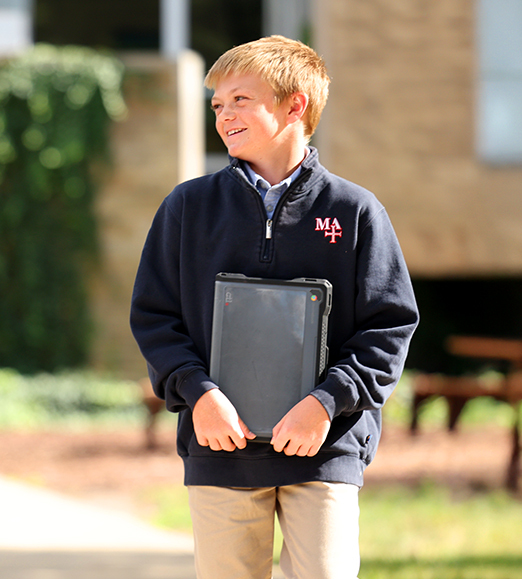
Tech
One-To-One Technology
A $500 annual technology fee includes:
- iPad, charger, and case (leased for the school year)
- Access to educational apps and eBooks
- AppleCare+ warranty
- On-campus IT support
- Printing access
- Marmion network and infrastructure services